
Sleep anxiety in children and teens is bedtime-triggered worry or fear that makes it hard for them to fall asleep or stay asleep. It’s often driven by learned reassurance patterns, separation anxiety, fear of the dark, stress, ADHD/autism traits, screens or caffeine, and irregular schedules. A consistent plan can help, and persistent cases should be evaluated by a clinician.
What “sleep anxiety” looks like vs normal bedtime resistance
All kids test boundaries. That’s normal. Sleep anxiety is different because it’s not just “I don’t want to go to bed.” It’s more like: “I can’t.”
Normal bedtime resistance often looks like:
-
Negotiating (“One more book.”)
-
Mild complaining
-
Brief protest that settles with clear limits
-
A child who can accept “no” without escalating
Sleep anxiety often looks like:
-
Fear + body arousal (fast heart, tense body, stomachaches)
-
Anticipatory worry that ramps up as bedtime approaches
-
Reassurance-seeking that grows over time (“Promise you’ll check again.” “Are you sure?”)
-
A pattern of bedtime and night behaviors that persist even when you “do everything right”
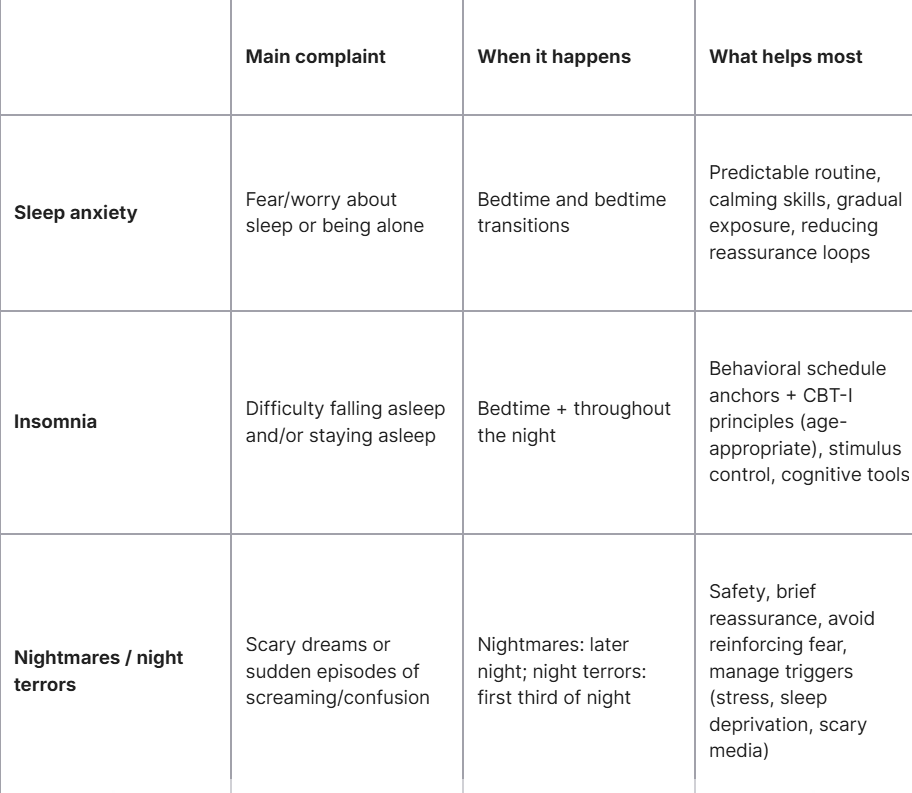
A related note: “sleep anxiety” can overlap with insomnia (a broader pattern of difficulty sleeping) and with parasomnias (nightmares, night terrors). The best plan depends on what’s actually happening.
Quick comparison table: Sleep anxiety vs insomnia vs nightmares/night terrors
Sleep Anxiety Symptoms in Children (By Age Group)
Use this as a quick checklist. Sleep anxiety tends to show up in nighttime signs and daytime spillover.
Nighttime signs
-
Long time to fall asleep (bedtime “takes forever”)
-
Fear of dark, being alone, or “bad things happening”
-
Repeated calls for a parent after lights-out
-
Repeated checking rituals (doors, closets, “monster checks”)
-
Refusing to sleep in their bed, climbing into parents’ bed
-
Night wakings with distress and difficulty resettling
Daytime signs
-
Irritability, meltdowns, low frustration tolerance
-
Clinginess and separation difficulty (especially younger kids)
-
Worry about tomorrow, perfectionism (often school-age and teens)
-
Daytime fatigue, trouble waking, dozing after school (often teens)
-
Somatic complaints: headaches, stomachaches, muscle tension
Physical arousal signs (often overlooked)
-
Rapid heart rate, shaky hands, sweaty palms
-
Restlessness, pacing, “wired but tired” energy
-
Nausea or “butterflies” at bedtime
Toddlers & Preschoolers (Ages 1–5)
At this age, the dominant driver is often separation anxiety. Some separation distress is developmentally normal. It becomes a concern when it’s intense, persistent, or escalating.
Common signs:
-
Crying or panic when you leave the room
-
Refusing to sleep alone
-
Repeated requests: water, hugs, “stay with me”
-
Fear of the dark or “things in the room”
-
Night wakings that require a parent to resettle
Why it happens:
-
Their brain is learning “object permanence” and attachment security.
-
Imagination is growing faster than logic.
-
Bedtime is a separation event, and separation can feel unsafe.
Your child isn’t “being difficult.” They’re trying to feel safe.
School-Age Children (Ages 6–12)
This is where pre-sleep cognitive arousal shows up. Worries get more complex: school performance, friendships, social dynamics, health fears, family concerns.
Common signs:
-
Taking 30–90+ minutes to fall asleep
-
“I can’t stop thinking”
-
Frequent reassurance questions and checking behaviors
-
Night wakings and coming to parents’ room
-
Bedtime stomachaches/headaches (real sensations driven by arousal)
In pediatric studies, younger children tend to show more nighttime wakings and sleep anxiety than adolescents.
For many kids ages 6–12, sleep anxiety is tangled up with neurodevelopmental differences like ADHD or autism. These children may find it extra hard to shift gears from busy daytime activities to the quiet of bedtime. Sensory sensitivities, like discomfort with pajamas, bedding textures, or nighttime noises, can make settling down even tougher. Many also get “stuck” on worries or routines (rumination or rigidity), making it harder for their brains to wind down.
If your child struggles with transitions or has strong preferences about bedtime routines or their sleep environment, this may be part of why falling asleep feels so difficult.
Teens (Ages 13–18)
In teens, sleep anxiety often becomes quieter, and more costly.
Less obvious bedtime resistance. More:
-
Racing thoughts, rumination, doom-scrolling
-
Difficulty waking, heavy morning sleepiness
-
Mood swings, social withdrawal, lower motivation
-
Academic decline from chronic sleep loss
-
Weekend “catch-up” sleep that shifts the body clock
There’s also a stress hormone loop: anxiety can raise cortisol, which delays sleep onset. Then sleep loss can increase stress reactivity the next day, reinforcing the cycle.
Compounding factors:
-
Social media and late-night group chats
-
Caffeine/energy drinks
-
Delayed sleep-wake phase patterns (circadian shift)
-
Inconsistent schedules
The American Academy of Sleep Medicine recommends 8–10 hours of sleep for ages 13–18.
Anxiety prevalence is high in adolescence. Estimates commonly cite roughly 1 in 3 adolescents experiencing an anxiety disorder at some point.
What Triggers Sleep Anxiety in Children?
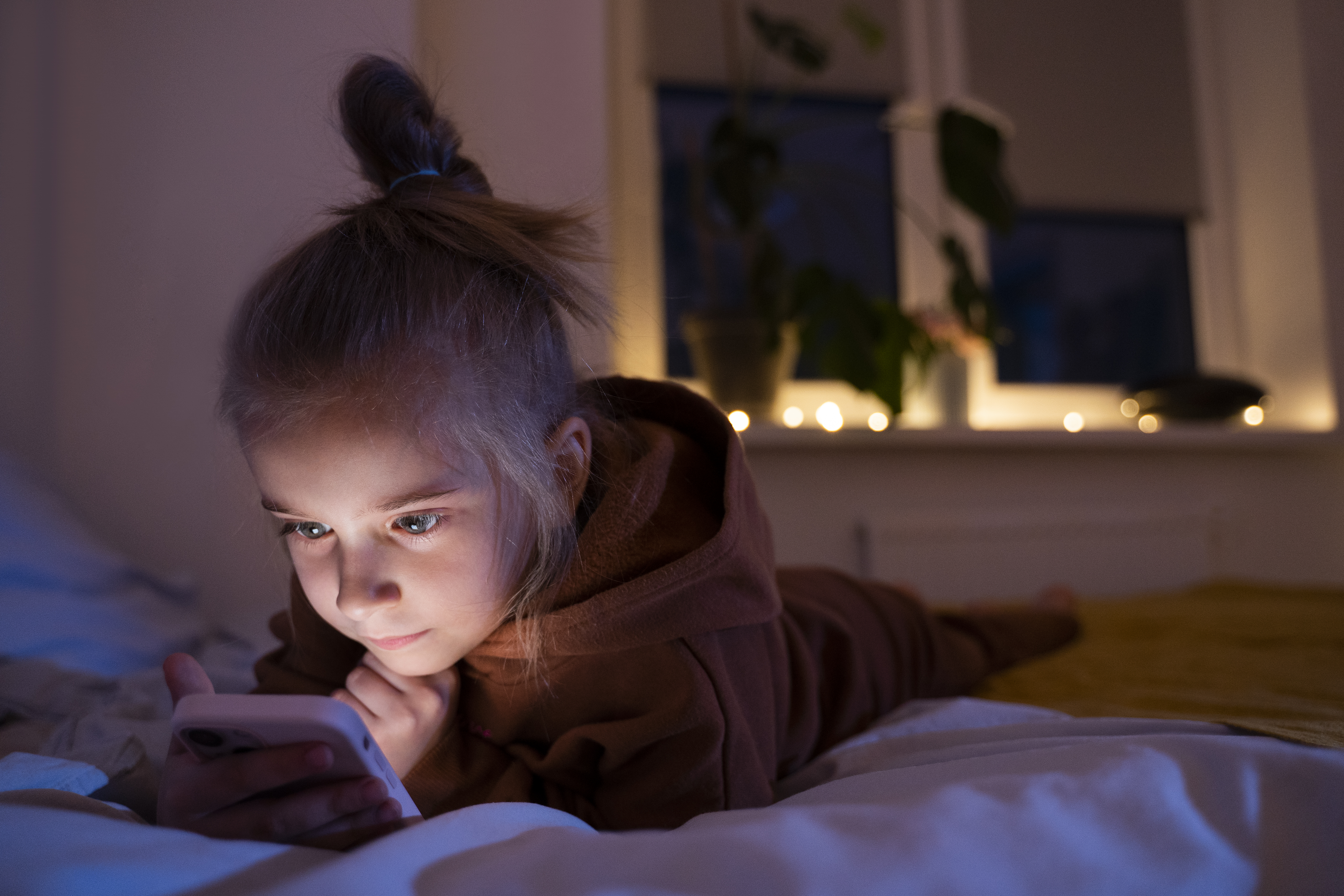
Think multi-factor model: biology + learning + environment + stress.
This is not about blame. It’s about accuracy. When you find the main driver, you stop guessing and start helping.
Common triggers include:
-
School stress, social pressure, performance anxiety
-
Family conflict or instability
-
Trauma or major life changes (new school, divorce, bereavement)
-
Fear of the dark, nightmares, night terrors
-
Screens close to bedtime (blue light plus mental activation)
-
Parental stress (kids often “borrow” nervous system states)
-
Biological vulnerability: anxious children can show higher pre-sleep arousal; elevated cortisol patterns have been observed in anxious pediatric groups compared to controls
Developmental fears: dark, monsters, vivid imagination
Ages roughly 3–8 are prime time for imaginative fears.
Your child’s brain can create vivid scenarios, but it cannot reliably reality-check them at 9:00 pm in a dark room.
What you might hear:
-
“What if someone breaks in?”
-
“I saw a face in the closet.”
-
“My brain is making scary pictures.”
A common trap: endless reassurance. It feels loving, but it can teach the brain: “This must be dangerous, because we keep checking.”
Better goal: teach safety and skills, not proofs and debates.
Separation anxiety at bedtime
Separation anxiety at night is distress when the caregiver leaves. It can become a pattern through intermittent reinforcement:
-
Child protests.
-
Parent stays longer “just this once.”
-
Child’s brain learns: protesting sometimes works.
-
Protesting increases.
Common times it spikes:
-
After travel
-
After illness
-
After starting school
-
After a new sibling
-
During parental stress or schedule changes
The fix is usually a gradual plan + consistent response.
Stress and life events: family conflict, school pressure, bereavements
The quiet of bedtime makes thoughts louder.
Stress often shows up as:
-
“I don’t feel good” right when lights go out
-
Tearfulness that seems to come out of nowhere
-
Big questions at bedtime (“Are you going to die?” “What if I fail?”)
A gentle script (that doesn’t start a negotiation):
-
“I hear you. Your body is holding a lot today.”
-
“We can talk about this tomorrow at (specific time).”
-
“Right now we’re doing sleep steps: body calm, mind calm, lights out.”
If grief or anxiety is intense, persistent, or impairing, it may warrant professional support.
Neurodiversity and mental health: ADHD, autism, generalized anxiety
Sleep anxiety often co-exists with neurodiversity and anxiety disorders.
-
ADHD: transitions are hard, minds race, routines get inconsistent. Medication timing can affect sleep. Talk with your prescriber if sleep onset shifts dramatically.
-
Autism: sensory sensitivities, high need for predictability, anxiety with change. The plan often hinges on environment, sensory safety, and very consistent cues.
-
Generalized anxiety: Kids and teens with generalized anxiety disorder (GAD) may have bedtime worries that spiral; concerns about school performance, friendships, or even world events. Perfectionistic thinking (“I can't make a mistake tomorrow”) and catastrophic predictions (“What if something bad happens while I’m asleep?”) can keep their minds active long after lights out. Difficulty tolerating uncertainty means they often seek reassurance or struggle to let go of “what if” questions at night. Simple bedtime routines may not be enough; kids with GAD typically benefit from learning specific coping skills to manage anxious thoughts.
Environmental and behavioral contributors: screens, blue light, caffeine, irregular schedules
Mechanisms, simply:
-
Blue light can suppress melatonin and delay sleepiness.
-
Stimulating content raises cognitive and emotional arousal.
-
Late naps reduce sleep pressure.
-
Irregular schedules confuse the circadian system.
Practical cutoff guidance (family-based, not punitive):
-
Ages 2–5: avoid screens in the last 60 minutes before bed (ideally longer).
-
Ages 6–12: aim for 60–90 minutes screen-free.
-
Teens: negotiate a realistic plan, but protect the last 60 minutes and keep the phone out of bed.
Teen-specific callout: late-night social media and gaming are not just “screen time.” They are social and reward activation, which can keep the brain on alert.
Can Anxiety Cause Disrupted Sleep Patterns in Children?
Yes, and it goes both ways: anxiety can disrupt sleep, and disrupted sleep can worsen anxiety in children. It's a bidirectional relationship.
Anxiety tends to:
-
Increase sleep onset latency (takes longer to fall asleep)
-
Increase night wakings
-
Fragment sleep architecture
-
Increase light sleep and arousal responses
Plain-language cycle:
-
Anxiety → racing thoughts + body arousal → delayed sleep
-
Poor sleep → weaker emotion regulation
-
Weaker regulation → bigger anxiety the next day
-
Repeat, until bedtime becomes a learned stress cue
Evidence supports this bidirectional relationship. Prospective research shows sleep problems can predict escalating anxiety symptoms in early adolescence, and persistent childhood insomnia has been associated with later anxiety symptoms. Reviews also note that a large proportion of anxious youth report clinically significant sleep disturbance.
How to Help a Child or Teen with Sleep Anxiety
You do not need 27 strategies. You need 2–3 strategies done consistently.
Consistency beats intensity. Every time.
Toddlers & preschoolers (2–5): safety, predictability, and short goodbyes
1) Keep the routine short and repeatable (20–30 minutes).
Same steps. Same order. Example:
-
Bath
-
Brush teeth
-
2 books
-
Lights dim
-
Song
-
Goodnight phrase
2) Use a transitional object as a “comfort cue.”
A stuffed animal or blanket can be a nervous system anchor.
3) Create a “brave plan” (graduated fading).
-
Night 1–2: Sit next to bed, minimal talking.
-
Night 3–4: Move chair halfway to door.
-
Night 5–6: Sit at doorway.
-
Night 7+: Brief check, then out.
Calming script (validate + reassure + return to routine):
“I know you want me to stay. It’s hard when we say goodnight. You are safe. It’s bedtime now. I’ll check on you in five minutes.”
School-age kids (6–12): skills over reassurance
1) Teach one body skill (practice during the day, use at night).
Try 4–6 breathing: inhale 4, exhale 6, for 2–3 minutes.
2) Teach one cognitive tool: “worry vs fact.”
Make a simple card:
-
Worry: “Something bad will happen.”
-
Fact: “I’m in my house, with grown-ups nearby.”
-
Plan: “If I feel scared, I do breaths and hug my bear.”
3) Use a “worry box” or “draw the fear” routine.
Externalize it:
-
Draw it.
-
Name it.
-
Put it in the box.
-
Close the lid. Your message is: “You can have fears and still sleep.”
Nightmare plan (brief comfort, no long reset):
-
Quick reassurance
-
Bathroom if needed
-
Back to bed with a calm tool
-
Daytime rescripting for recurring nightmares (change the ending while awake)
Also consider limiting fear triggers: scary media, older siblings’ content, bedtime conflict.
Teens (13–18): circadian timing, autonomy, and mental load
Teens need ownership. If you try to “control” sleep, you often create more stress.
1) Anchor the wake time (most powerful lever).
Pick a realistic consistent wake time. Keep weekend drift limited when possible.
2) Get bright light in the first hour after waking.
Morning light helps set circadian timing. If mornings are dark, consider discussing a light box with a clinician.
3) Build a phone plan that protects sleep without power struggles.
-
Charge outside the bedroom.
-
Use Focus mode.
-
Pre-commit together: “I want my sleep more than I want the scroll.”
4) Cognitive offload (close open loops).
-
10-minute “tomorrow list”
-
10-minute “worry time” earlier evening (not in bed)
If insomnia is persistent and impairing, consider CBT-I with a qualified clinician (teen-adapted).
The SSA bedtime framework: Calm body → calm mind → consistent cues
This is SSA’s practical lens: sleep improves when the system is recalibrated. Not forced. Not chased. Supported.
Use this as a simple nightly sequence.
Educational guidance only. If you suspect a medical condition, consult a clinician.
Step 1: Calm the body (downshift arousal)
Pick 2–3:
-
Slow breathing (4–6 breathing)
-
Warm bath or shower
-
Gentle stretching
-
Weighted blanket if tolerated and safe for the child (sensory-safe, age-appropriate)
-
“Calm corner” in the bedroom (soft light, book, stuffed animal)
Avoid:
-
Roughhousing
-
Intense problem-solving talks
-
Competitive games in the last 60 minutes before bed.
Step 2: Calm the mind (close open loops)
Tools that work because they give attention an anchor:
-
Reading calming books (paper is often better than screens)
-
Guided imagery for kids (“safe place” visualization)
-
For teens: journaling, brain-dump, or a short gratitude list (not forced)
Boundary that matters: Validate feelings without reinforcing specific fears.
-
For example: “That felt scary. Your body is safe. Let’s do your calm breaths.”
Step 3: Consistent cues (teach the brain: bed = safe + sleepy)
Consistency builds safety signals.
Focus on:
-
Stable sleep/wake anchors
-
Cool, dark, quiet room (nightlight is fine if it reduces fear)
-
Reduce clutter that creates “shadow shapes”
-
A parent response plan that is calm, brief, and boring
Parent response plan example:
-
Walk child back.
-
Minimal talking.
-
Repeat one phrase: “It’s sleep time. You’re safe.”
-
Leave as planned.
This is how you break the reassurance loop kindly.
What to avoid (common mistakes that keep the cycle going)
These are common because they work short-term. They just backfire long-term.
-
Long negotiations at bedtime (teaches stalling works)
-
Escalating reassurance without a taper plan (teaches “danger”)
-
Melatonin as the only strategy (may shift timing short-term but doesn’t retrain anxiety responses)
-
Punishment or shaming for fear (increases arousal and mistrust)
-
Turning bedtime into interrogation (“Why are you anxious?”) when the child is already activated
Melatonin, supplements, and meds: what parents should know
Melatonin can be helpful for some kids, especially for shifting sleep timing in certain circadian patterns, but it is not a complete plan for anxiety-driven sleep issues.
Current research suggests that while melatonin may help children fall asleep faster in some cases, its effectiveness for sleep anxiety specifically is limited. Most studies focus on insomnia or circadian rhythm delays; there’s far less evidence supporting melatonin as a treatment for bedtime fears, nighttime worries, or anxiety-based sleep disruption. Anxiety-driven sleep issues usually require changes in routines and coping skills to address the root causes; not just adjusting the body's clock.
Age matters: Melatonin is generally not recommended for children under age 3 without medical supervision, as younger children’s brains and bodies are still developing natural sleep rhythms. Even in older children, use should always be discussed with a pediatrician to weigh risks, monitor side effects, and avoid interactions with other medications or conditions.
It’s important to remember that melatonin isn’t a substitute for behavioral strategies. Supplements may help shift sleep timing temporarily but don’t resolve the underlying habits, fears, or thought patterns that fuel sleep anxiety. Building consistent routines and teaching coping skills remain the foundation.
When to seek professional help
Consider getting help if:
-
Symptoms persist longer than 4–6 weeks despite consistent changes
-
Severe daytime impairment (school refusal, major mood impact)
-
Panic symptoms, self-harm talk, or safety concerns
-
Trauma signs, severe grief, or sudden major regression
-
Frequent night terrors, intense parasomnias, or dangerous behaviors
-
Suspected sleep apnea (snoring, gasping), restless legs, or other medical sleep issues
Who to see:
-
Pediatrician (first step)
-
Pediatric sleep specialist (sleep disorders, complex cases)
-
Child psychologist/therapist for anxiety support
-
CBT-I trained provider for persistent insomnia (teen-adapted)
Sleep Science Academy provides education and coaching. We do not diagnose or treat medical or mental health conditions.
Helping your child/teen overcome sleep anxiety: the path forward
Supporting a child/teen with sleep anxiety involves ongoing challenges that disrupt both nights and days.
-
Map out your child’s unique sleep anxiety triggers and patterns using age-specific signs, not just bedtime protests.
-
Use routines and consistent cues to teach the brain that bed means safety and sleep; not battle or fear.
-
Prioritize coping skills over repeated reassurance; help your child learn to handle worries at night instead of only seeking comfort.
Sleep anxiety changes with age, but consistency and skill-building shift the cycle. Progress happens when you focus on what your child can do, not just how they feel.
Access practical tools, step-by-step guides, and coaching options for families facing sleep anxiety at Sleep Science Academy.