
If you’re exhausted, frustrated, and tired of being tired, “sleepmaxxing” probably sounds tempting. A few tweaks. A few gadgets. Finally, sleep.
And if you’re someone who likes to optimize everything: your workouts, your focus, your mood, why wouldn’t you want to dial in your sleep too? After all, it’s the foundation for everything else.
But here’s the truth from the Sleep Science Academy: sleep isn’t a problem to fix, it’s a result. When your nervous system, body clock, and natural sleep drive are in sync, good sleep tends to follow. If they’re out of whack, no amount of TikTok hacks or shiny new tech will keep you from staring at the ceiling at 2 a.m.
So what does “better sleep” actually look like in real life?
-
You fall asleep easier (less tossing and turning)
-
You wake up less (or get back to sleep faster)
-
Your sleep feels deeper and more restorative
-
Your sleep efficiency improves (more time asleep while you’re in bed)
-
You wake up more refreshed, with better mood and energy
One thing to keep in mind: trends can help, but the basics always matter most. It’s not about chasing perfect sleep, or forcing yourself to conk out. It’s about setting up the right conditions so real rest can happen naturally.
The four sleepmaxxing trends most likely to improve sleep quality are temperature control and smart beds for hot sleepers and night wakings, CBT-I-style sleep coaching frameworks for chronic insomnia and racing-mind nights, mouth taping (only if safe and appropriate) for dry mouth and mouth breathing, and incline sleeping for reflux, post-nasal drip, and some snoring patterns.
What is sleepmaxxing?
Sleepmaxxing refers to the new wave of routines, products, and hacks aimed at optimizing sleep quality beyond traditional “sleep hygiene.” The term exploded on TikTok and Instagram in 2024, fueled by creators sharing tech-driven experiments.
UCLA sleep medicine physician Dr. Sam Kashani has described sleepmaxxing as a modern, amplified version of sleep hygiene. This trend spotlights four main approaches: temperature control and smart beds, CBT-I-style sleep coaching, mouth taping (when appropriate), and incline sleeping.
Trend #1: Temperature control and smart beds
If you only try one sleepmaxxing trend, make it this one.
Why temperature works
Your body needs to cool down to fall asleep and stay asleep. Sleep onset is linked with a drop in core body temperature, and when your sleep environment is too warm, sleep can fragment with more awakenings.
This is one reason hot sleepers often report:
-
“I fall asleep, then wake up at 2–3 a.m. sweaty.”
-
“I can’t get comfortable.”
-
“My sleep is light and broken.”
Step-by-step: the simplest temperature plan
1) Set a target room range (start here).
Most people do well around 60–67°F (15.5–19.5°C), but your personal sweet spot matters more than internet rules.
2) Pre-cool the room.
Don’t wait until you’re already overheating. Cool the room 30–60 minutes before bed.
3) Use breathable bedding.
Look for cotton percale, linen, bamboo viscose blends, or other breathable materials. Avoid heavy, heat-trapping layers.
4) Try the “cool torso, warm feet” trick.
Warm feet can help heat leave your core via distal vasodilation, while a cooler torso helps prevent overheating. Practical ways:
-
light socks plus a cooler comforter
-
a small heating pad near feet (not the core) while keeping the room cool
5) Time your shower.
A warm shower 1–2 hours before bed can help by raising skin temperature and then promoting a cool-down afterward.
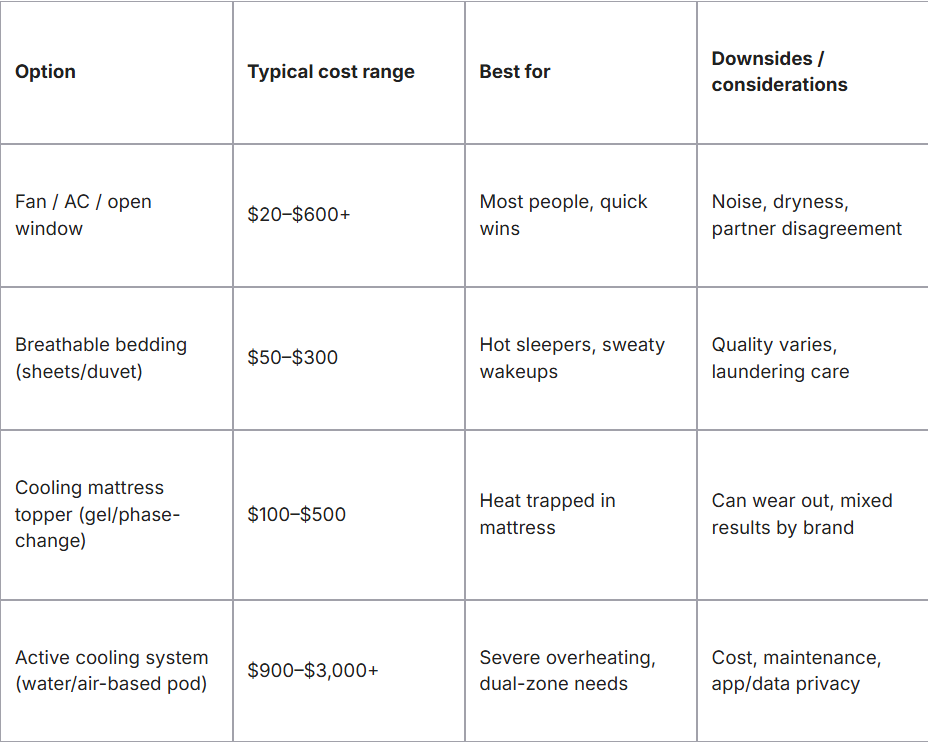
Mini comparison table: temperature-control options (budget → premium)
Buyer checklist (don’t skip this)
If you’re buying anything beyond sheets, check:
-
Noise level (some “silent” devices are not silent at 2 a.m.)
-
Dual-zone support (if you share a bed and sleep at different temps)
-
Cleaning and maintenance (especially water-based systems)
-
Warranty and return policy (your body is the real compatibility test)
-
Data privacy (if it’s app-connected, know what’s being collected)
Bottom line: temperature control is one of the most evidence-aligned, high-leverage changes because it supports biology instead of fighting it.
Trend #2: “Sleep coaching” goes mainstream: CBT-I + Dynamic Sleep Recalibration (DSR) style implementation
For chronic insomnia, this is the trend that moves the needle.
Why this works
When insomnia persists, CBT-I (Cognitive Behavioral Therapy for Insomnia) is the gold standard. It’s widely recommended as a first-line treatment for chronic insomnia by major clinical guidelines, including the American College of Physicians and the American Academy of Sleep Medicine.
We focus on coaching and education, not therapy or medical treatment, but our approach is grounded in proven CBT-I principles. Our implementation method, Dynamic Sleep Recalibrating (DSR), adds structure, nervous system regulation, and step-by-step habit building so you move from “knowing” to consistently doing.
What CBT-I typically includes
-
Stimulus control: Train your bed/bedroom to cue sleep, not frustration.
-
Sleep restriction/compression: Limit time in bed to rebuild drive and improve efficiency.
-
Cognitive restructuring: Address unhelpful thoughts that fuel anxiety and hyperarousal.
-
Circadian anchoring: Stabilize your rhythm with consistent wake times and morning light.
-
Wind-down skills: Use relaxation/breathwork to downshift before bed and handle “can’t sleep” moments.
These five components align with established clinical guidelines.
The “Anchor + Window + Wind-down” framework
A simple way to put CBT-I principles into action:
1) Anchor: Consistent wake time + morning light + movement
Choose a wake time you can keep most days, including weekends.
Add:
-
10–30 minutes outdoor light within an hour of waking (cloudy days count)
-
5–10 minutes gentle movement (walk, stretches, easy cycling)
This steadies your circadian rhythm and reduces social jet lag.
2) Window: Match bed time to real sleep ability
If you spend 9 hours in bed but only sleep 6.5, your brain links bed with wakefulness.
Instead:
-
Fix your wake time (e.g., 7:00 a.m.)
-
Base your window on current average sleep (e.g., 6.5 hours)
-
Adjust bedtime accordingly (e.g., 12:00–12:30 a.m.)
Each week:
-
If sleep efficiency improves, add 15 minutes
-
If awake a lot at night, subtract 15 minutes (get guidance for severe insomnia)
First rebuild efficiency then gradually expand total sleep time.
3) Wind-down: 30–60 minutes of low stimulation
Aim for downshifting.
-
Dim lights
-
Warm shower (followed by cool room)
-
Light reading (paper or e-ink)
-
Gentle breathwork/muscle relaxation
Set phone boundaries before bed, until your brain stops linking bed with screens.
If you can’t sleep: Don’t force it. Get up for a few minutes in low light; return when sleepy.
Troubleshooting tips
-
Early waking: Protect your anchor wake time, temporarily tighten your window, avoid long naps.
-
Racing mind: Schedule a dedicated “worry time” earlier; use a repeatable wind-down routine.
-
Shift work: Anchor what you can: light exposure, consistent timing, stable sleep environment, and minimize frequent schedule changes.
-
Dynamic Sleep Recalibrating (DSR) is simply how we structure these steps into real-life routines people can stick with.
Trend #3: Mouth taping for sleep
Mouth taping is everywhere in sleepmaxxing content. The promise is simple: tape your mouth, breathe through your nose, sleep better.
What it may help (mechanism, with caution)
Nasal breathing can reduce dry mouth and may support steadier breathing patterns for some people. For some, it’s also a reminder to keep the jaw relaxed rather than hanging open all night.
Emphasis on may. People vary a lot.
What the evidence says (and the risks)
A 2025 PLOS One review (10 studies, 213 patients) found mixed results. Two studies showed improvement in some sleep apnea markers, and several raised concerns including asphyxiation risk when nasal breathing is impaired.
Who must avoid mouth taping
Do not mouth tape if you have:
-
nasal obstruction or chronic congestion
-
suspected sleep apnea (snoring, gasping, daytime sleepiness)
-
a deviated septum that limits nasal airflow
-
panic around restricted breathing
-
any condition where safe breathing through the nose is not consistently reliable
If you’re curious, speak with a qualified professional first, especially if snoring or apnea is on the table.
Verdict: low cost, modest potential upside, real risk for the wrong person. This is not a “everyone should do this” hack.
Trend #4: Incline sleeping: a low-risk experiment
Incline sleeping means elevating your upper body while you sleep, not just your head.
Who it can help
-
Nighttime GERD/reflux sufferers
-
Those with post-nasal drip
-
People with certain positional snoring patterns
-
Anyone who feels more comfortable slightly elevated
How to do it correctly
Avoid piling up pillows, which bends the neck forward and leads to discomfort or tension.
Instead, elevate your entire torso:
-
Use a wedge pillow that supports from mid-back upward
-
Place bed risers under the head of the bed (raising the frame itself)
-
Try an incline mattress pad designed for this purpose
Start with a gentle incline and adjust as needed for comfort.
Mechanism notes
-
Reflux/GERD: Elevating the head and upper torso helps keep stomach acid in the stomach by using gravity; a practical approach. Raising the head of the bed is a recognized recommendation for managing nocturnal GERD symptoms.
-
Glymphatic drainage: There is some speculation about elevation aiding brain waste clearance during sleep, but this remains theoretical and hasn’t been confirmed in large human studies.
-
Snoring: Elevation may help reduce positional snoring by keeping airways more open, but it does not treat obstructive sleep apnea.
How: Most people start with about 6 inches of elevation using bed risers or a properly sized wedge.
Verdict: Affordable, low-risk, and modestly supported by evidence. Worth trying if reflux, nasal drip, or mild snoring are issues for you.
Putting it together: a 14-day sleepmaxxing plan
You don’t need 14 new habits. You need a short plan you can actually follow.
Days 1–3: baseline + anchor + temperature plan
-
Track: bedtime, wake time, awakenings, how you feel in the morning
-
Set a consistent anchor wake time
-
Choose your temperature approach (room temp + bedding at minimum)
Days 4–7: implement Anchor + Window + Wind-down
-
Keep wake time consistent
-
Set a realistic sleep window (aim to improve sleep efficiency first)
-
Build a 30–60 minute wind-down you can repeat
Days 8–10: add one upgrade only
Pick one:
-
A cooling upgrade (bedding/topper/device), or
-
An environmental tweak (noise reduction, blackout, pre-cooling schedule)
Keep the behavior framework constant so you know what’s working.
Days 11–14: add one targeted experiment
Pick one:
-
Incline sleeping (if reflux/snoring/post-nasal drip)
-
Mouth taping on-ramp (only if appropriate and safe)
Success criteria (progress over perfection)
Look for:
-
Fewer awakenings
-
Faster return to sleep
-
Better morning energy
-
More restorative sleep feel
-
Less anxiety about sleep
Wrap-up: sleepmaxxing that restores your natural sleep
If you’re feeling both hopeful and overwhelmed by sleepmaxxing, remember: sleep improves when the right conditions are in place, consistently, not from chasing the perfect hack. Focus on creating supportive routines and environments, and results will follow.
Recap the four trends, and who should prioritize what:
-
Temperature control / smart beds: prioritize this if you’re a hot sleeper or wake up sweaty and wired.
-
CBT-I-style coaching frameworks (Anchor + Window + Wind-down): prioritize this if you’re an exhausted insomniac with broken sleep and sleep anxiety.
-
Mouth taping: only consider if nasal breathing is reliably clear and you’ve ruled out red flags like apnea.
-
Incline sleeping: prioritize this if reflux, post-nasal drip, or certain snoring patterns show up at night.
Medical Disclaimer: This article is for educational purposes only and is not medical advice. Sleep problems may be linked to underlying health conditions, medications, mental health concerns, or sleep disorders. If you have chronic insomnia, loud snoring, gasping during sleep, excessive daytime sleepiness, breathing issues, or persistent reflux, consult a qualified healthcare professional before trying mouth taping, supplements, sleep restriction, or other sleep interventions.